MULTI-TENANT / ORGANIZATIONS / ACCESS / DATA ISOLATION / SCALE
One platform. Many organizations. Clear separation.
Jenrix builds tenant-based platforms where multiple companies, branches, departments or customer accounts can use the same software while keeping their users, data, permissions and workflows properly separated.
This architecture is ideal for SaaS products, CRM platforms, business operating systems, marketplaces and enterprise software where one platform needs to serve many independent organizations.
ORGANIZATION ACCOUNTS
DATA ISOLATION
ROLE CONTROL
SHARED INFRASTRUCTURE
JENRIX / TENANT ARCHITECTURE
Organization → Users → Data → Workflow → Platform
TENANT SYSTEM ACTIVE
TENANTSISOLATED
USERSSCOPED
DATASEPARATED
WORKFLOWSINDEPENDENT
PLATFORMSHARED
JENRIX CORE
TENANT
ACCOUNT / ACCESS / DATA / CONTROL
LIVE TENANT EVENT
TENANT CREATED / DATA SCOPE ASSIGNED
THE BUSINESS IDEA
01
One software product can serve many customers without mixing their data or operations.
Multi-tenant architecture allows one platform to support many independent organizations while preserving tenant-specific users, data, configuration, workflows and permissions.
One Platform
Many Accounts
Separated Data
Central Control
WHY TENANT ARCHITECTURE MATTERS
Scaling to many customers should not mean building separate software every time.
Tenant-based architecture gives the business one maintainable platform while still giving every customer or organization a controlled operating environment.
Every new customer creates another technical environment.
- Infrastructure and deployments multiply
- Updates become harder to coordinate
- Support teams manage many separate versions
- Feature consistency becomes difficult
- Operational cost rises with every customer
One product, many independently controlled organizations.
- Shared platform services reduce duplication
- Each tenant has its own users and access scope
- Tenant data remains logically separated
- Platform updates can serve all customers together
- Central administration supports growth more cleanly
TENANT PLATFORM CAPABILITIES
Separation where needed. Shared infrastructure where it creates leverage.
Jenrix structures tenant platforms around organization identity, scoped access, tenant data, workflow independence and central platform control.
Organization Accounts
Each tenant represents an independent company, customer, workspace, branch or operating unit.
Role-Based Access
Users receive permissions within the context of their own tenant and assigned operating role.
Tenant Data Isolation
Records, documents, activity and reporting remain scoped to the correct organization.
Tenant Configuration
Organizations can have their own settings, workflows, branding, modules or operating rules.
Workflow Independence
Each tenant can run tasks, approvals, automations and operational processes independently.
Central Platform Admin
Manage tenants, users, plans, configuration, support and platform activity from one control layer.
Shared Platform Services
Common APIs, infrastructure, security, deployment and core application services can be centrally maintained.
Scalable SaaS Growth
Add organizations, users, product modules and operational volume without rebuilding the product per customer.
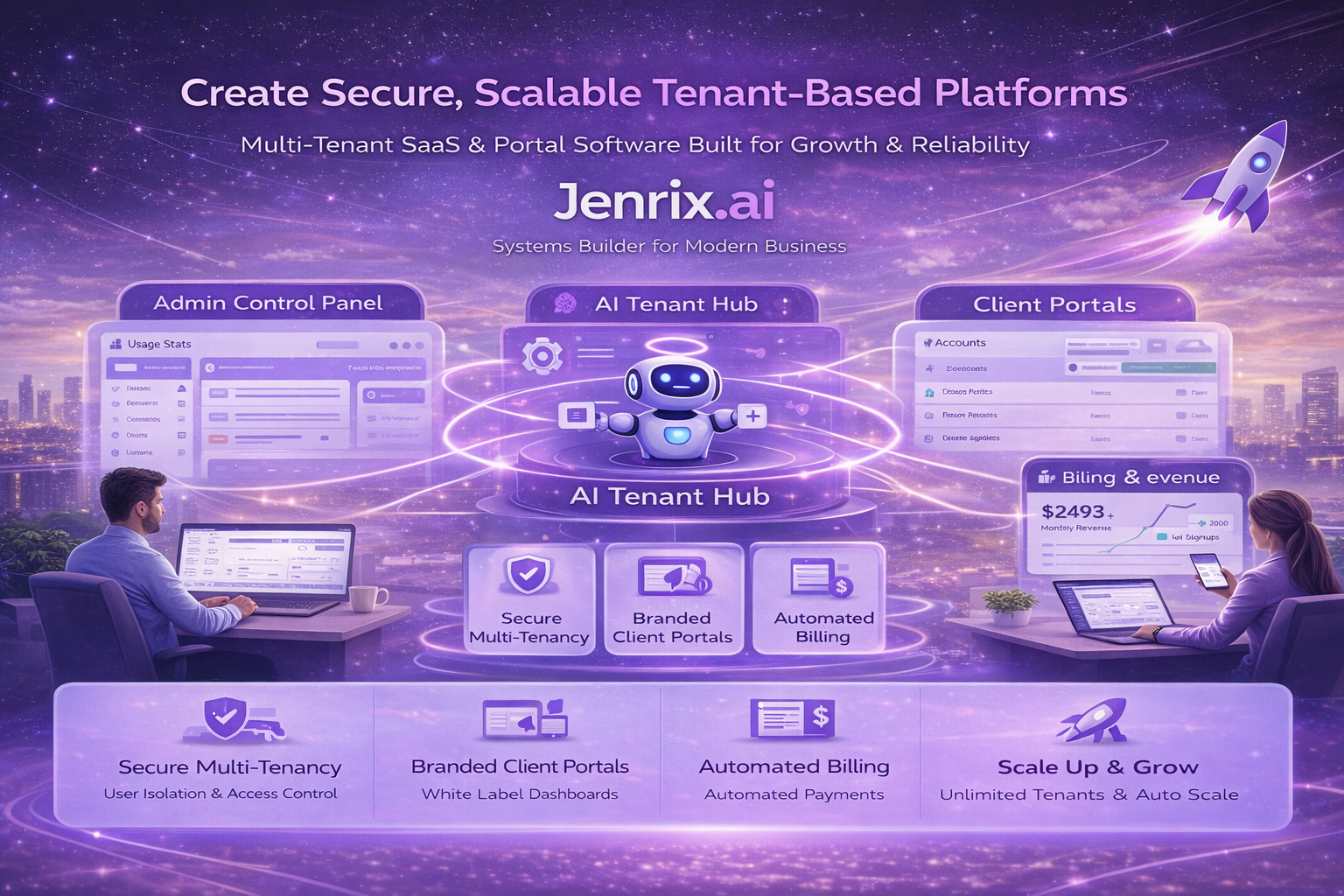
TENANT PLATFORM REFERENCE
Tenant architecture should make separation and shared scale easy to understand.
Your existing tenant visual remains useful as a supporting reference, while the live architecture above explains how organizations, users, data, workflows and central platform services fit together.
JENRIX / TENANT PLATFORM REFERENCE
TENANT PLATFORM DESIGN MODEL
Multi-tenancy works when account boundaries are designed deliberately.
Jenrix defines who the tenant is, what belongs to that tenant, what can be shared, and how platform administration should operate across all organizations.
STEP 01
Define the Tenant
Identify whether the tenant is a company, branch, customer, workspace or operating unit.
STEP 02
Define the Boundaries
Determine which users, records, settings, workflows and data belong to each tenant.
STEP 03
Define Shared Services
Structure common platform services, APIs, infrastructure, administration and deployment.
STEP 04
Design for Growth
Plan how new tenants, users, plans, modules and volume will be handled as the platform expands.
TENANT-BASED PLATFORM USE CASES
Best suited to products where many organizations use the same core platform.
SaaS Products
One product serving many independent customer organizations with account separation and subscriptions.
CRM Platforms
Sales and customer systems used independently by many companies on shared software infrastructure.
Business Operations Platforms
Platforms serving multiple business units, branches, franchises, customers or operating companies.
Marketplace Systems
Platforms where vendors, partners or service providers operate within separate controlled accounts.
Analytics Platforms
Shared reporting infrastructure delivering tenant-specific dashboards and metrics to many organizations.
AI-Enabled SaaS
Multi-organization platforms enhanced with AI while preserving tenant data scope and user permissions.
TENANT PLATFORM FAQ
Questions before building a multi-tenant platform.
What is a tenant in a software platform? +
A tenant is an independent organization, customer account, workspace, branch or business unit that uses the same platform while keeping its own users, data, configuration and operating context.
Can each tenant have different users and permissions? +
Yes. Each tenant can have its own administrators, managers, operators, analysts and permission rules, depending on the product design.
Can tenants have different workflows or settings? +
Yes. Depending on the architecture, each tenant can have its own configuration, workflow rules, modules, branding, notifications and operational settings while still using the same platform core.
Can tenant-based architecture support subscriptions and SaaS billing? +
Yes. Tenant accounts can be linked with plans, entitlements, subscription states, limits and billing logic where the product model requires it.
RELATED JENRIX PLATFORM ENGINEERING
BUILD ONE PLATFORM THAT CAN SERVE MANY ORGANIZATIONS
Multi-tenancy should create leverage, not operational confusion.
Share your SaaS, CRM, marketplace or multi-organization platform requirement. Jenrix can help structure the tenant model, user roles, data boundaries, workflows and platform control layer.