Map how work actually moves
Users, roles, workflows, handoffs, decisions, bottlenecks, data origins and operational dependencies.
OUTPUT / OPERATING MAPThe Jenrix Systems Architecture Framework translates business workflows into connected applications, automation, AI, data, APIs and infrastructure before engineering complexity compounds.
We map users, processes, decisions, data, integrations and operating constraints first. Those relationships become the foundation for CRM ecosystems, SaaS platforms, enterprise software, AI-enabled workflows, dashboards and connected digital infrastructure.
At Jenrix, systems architecture is the structured design of applications, workflows, data, integrations, permissions, automation, AI and infrastructure around a real operating model. It establishes how the parts should interact before those parts become expensive to change.
Screens can be redesigned. Structural mistakes are harder: duplicated data, unclear permissions, brittle integrations, manual handoffs and application boundaries that no longer match the business.
Each phase reduces a different category of uncertainty. Together they create an architecture that can support software engineering, automation, AI, integration and continued growth.
Users, roles, workflows, handoffs, decisions, bottlenecks, data origins and operational dependencies.
OUTPUT / OPERATING MAPApplications, modules, services, entities, permissions, data relationships, APIs and integration boundaries.
OUTPUT / SYSTEM BLUEPRINTRouting, triggers, approvals, reminders, escalation, communication and exception handling.
OUTPUT / WORKFLOW MODELClassification, extraction, summarisation, recommendations, assistants and decision support connected to real workflows.
OUTPUT / AI OPPORTUNITY MAPFrontend, backend, SaaS, portals, dashboards, APIs, admin controls, integrations and business logic.
OUTPUT / WORKING PLATFORMCloud architecture, security, observability, performance, deployment, resilience and growth readiness.
OUTPUT / PRODUCTION ARCHITECTUREKPIs, dashboards, analytics, event visibility, management reporting and signals for continued optimisation.
OUTPUT / INTELLIGENCE LAYEREnterprise architecture becomes useful when each layer has a clear responsibility and the interfaces between layers are deliberate.
The existing Jenrix architecture diagram remains useful as a detailed reference. It now sits below the conceptual architecture sections instead of carrying the page by itself.
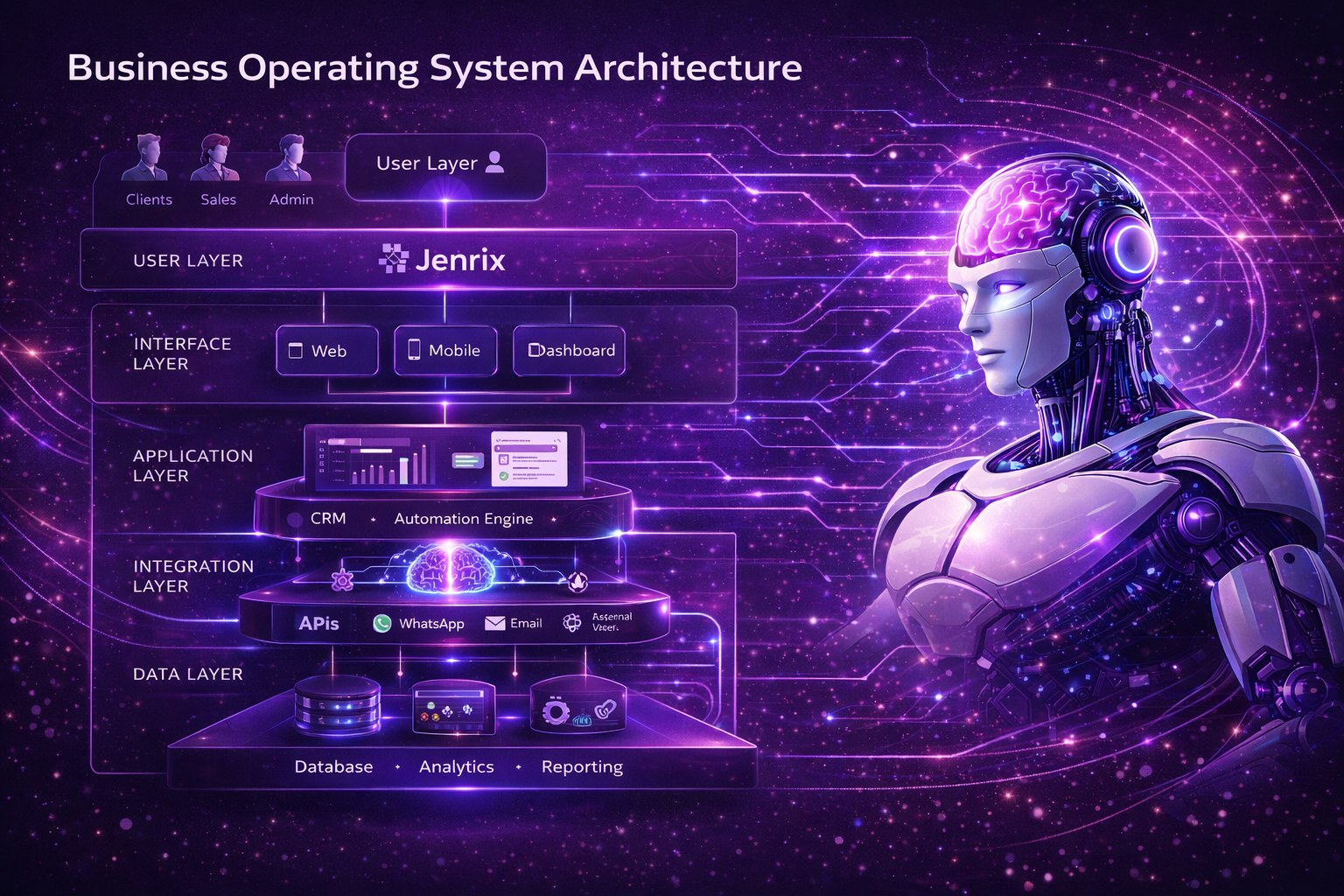
Architecture is useful only if it improves the quality, scalability and maintainability of the technology that is eventually built.
Lead movement, sales workflows, lifecycle, customer operations and revenue visibility.
02AUTOMATIONWorkflow PlatformsApprovals, routing, reminders, escalation, communication and process orchestration.
03SAASSaaS ProductsMulti-tenant architecture, users, roles, subscriptions, administration and product workflows.
04AI SYSTEMSAI-Enabled Business SystemsAssistants, document intelligence, classification, recommendations and decision support.
05DATADashboards & IntelligenceKPIs, operational reporting, analytics, executive visibility and decision-support interfaces.
06CONNECTED SYSTEMSAPIs, Integrations & IoTCRM, ERP, payments, cloud services, devices, telemetry, data pipelines and external systems.
Good architecture is a sequence of explicit decisions about ownership, boundaries, dependencies, control and future change.
Not every small project needs a formal architecture exercise. It matters most when the business expects multiple users, systems, workflows, integrations, automation, AI or long-term evolution.
Processes, reporting, permissions or data movement no longer scale with the organisation.
The product requires clear tenancy, roles, workflows, data structures and integration boundaries.
CRM, ERP, workflow, dashboards, APIs and operational data need to work together coherently.
AI and automation need context, permissions, workflow state and controlled access to business data.
Direct explanations for businesses evaluating enterprise architecture, software architecture, AI architecture or automation architecture work.
The framework is an architecture-first method for mapping business workflows, defining system boundaries, designing data and integration structures, planning automation and AI, engineering applications and preparing the resulting platform for scale and operational visibility.
Architecture-first design helps align applications, workflows, users, permissions, data, integrations, automation and infrastructure before feature complexity accumulates.
AI is introduced where business context, data, workflow state and permissions make it operationally useful, including document intelligence, classification, summarisation, recommendations, assistants and decision support.
The framework can support CRM and revenue systems, workflow automation platforms, enterprise applications, SaaS products, dashboards, AI-enabled business systems, APIs, data platforms, IoT-connected systems and broader digital transformation programs.
Bring us the business problem, workflows, platform idea or transformation objective. We can help map the system and define the architecture before engineering begins.