DATA / ANALYTICS / SIGNALS / DECISION INTELLIGENCE
Decision support that turns operational data into direction.
Jenrix engineers decision support layers that connect business data, KPIs, analytics, alerts and AI-assisted interpretation into one operating view for leaders, managers and teams.
The goal is not another reporting screen. The goal is to make important changes, risks, opportunities and priorities easier to understand — with enough context to support the next decision.
OPERATIONAL VISIBILITY ANALYTICS AI INTERPRETATION ACTION SIGNALS
JENRIX / DECISION INTELLIGENCE LAYEROperational Signals → Interpretation → Priority → Action
DECISION LAYER ACTIVE
SOURCES09 CONNECTED
SIGNALS64 ACTIVE
KPIsLIVE
AIASSISTED
ALERTSMONITORED
JENRIX COREDECIDEDATA / CONTEXT / SIGNAL / ACTION
LIVE DECISION EVENTKPI VARIANCE / PRIORITY SIGNAL GENERATED
DECISION SUPPORT SYSTEM01
Data becomes useful when it changes what happens next.
A strong decision layer connects information to business context: what changed, how significant it is, who owns it, what risk or opportunity it creates, and which action deserves attention.
Operational DataMetrics & ContextPriority & InsightBetter Decisions
WHY DECISION SYSTEMS MATTER
More reports do not automatically create better decisions.
Businesses often have plenty of data but still struggle to understand what matters now, why performance changed, where intervention is required and what deserves management attention.
Numbers are visible, but priorities remain unclear.
- Metrics exist across disconnected reports
- Leaders still interpret results manually
- Exceptions are buried in normal activity
- KPI definitions vary between teams
- Reporting explains the past but not the next action
Data, context and priority engineered into one operating view.
- Connected data feeds one decision layer
- KPIs align to ownership and objectives
- Thresholds make attention visible
- Analytics and AI add interpretation
- Signals connect insight with possible action
DECISION INTELLIGENCE CAPABILITIES
One decision layer. Multiple intelligence components.
Jenrix combines visibility, data modeling, analytics, signals, AI interpretation and action context around the decisions leaders and operating teams actually need to make.
Operational Dashboards
Live views across revenue, operations, customer activity and workflow performance.
Performance Analytics
Targets, variance, trends and comparisons structured around operating objectives.
Alerts & Exceptions
Thresholds, anomalies, missed actions and important changes surfaced for attention.
Predictive Insight
Forecasting and pattern recognition where the data quality and use case justify prediction.
AI Interpretation
Summaries, explanations, comparisons and recommendations layered onto reliable data.
Connected Data Sources
CRM, ERP, applications, APIs, databases and workflow systems.
Role-Based Decision Views
Different information and priorities for executives, managers, operators and teams.
Decision-to-Workflow Links
Connect signals with tasks, approvals, notifications and operational next steps.
DECISION SUPPORT REFERENCE
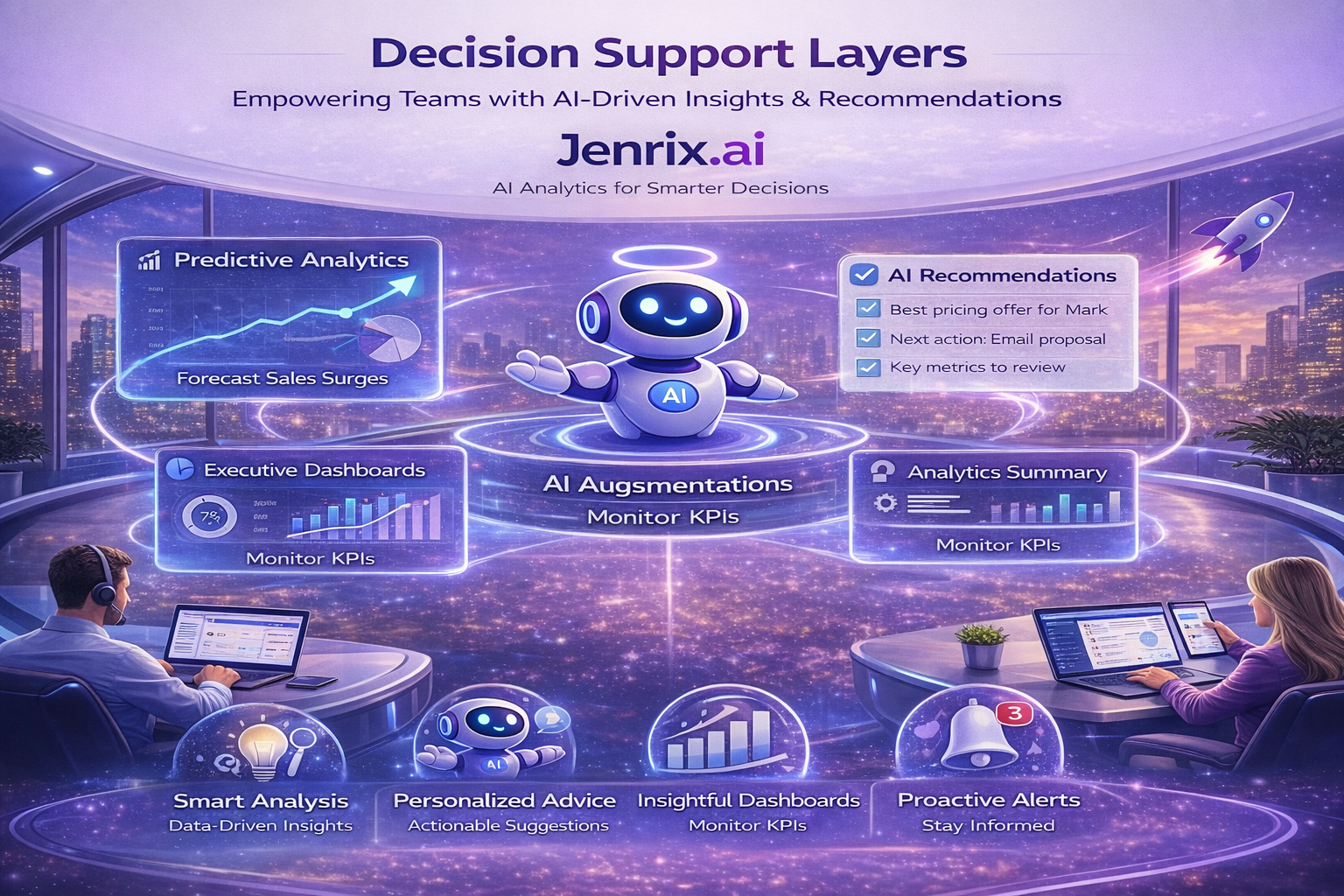
Visual dashboards should support the decision architecture beneath them.
Your existing decision-support image remains useful as a supporting reference, while the live system above communicates the decision logic more clearly.
JENRIX / DECISION SUPPORT REFERENCE
DECISION SUPPORT USE CASES
Different decisions require different information architecture.
Decision-support systems should be designed around the user, the decision they own, the signals they need and the actions available to them.
Executive Performance Views
Business health, revenue, targets and high-level exceptions for leadership.
Revenue Decision Support
Pipeline movement, conversion, response and sales-performance signals.
Operational Control
Queues, bottlenecks, approvals, workload and SLA risk.
Customer & Service Intelligence
Service trends, activity, requests, satisfaction signals and support exceptions.
Management Analytics
Performance comparisons, commercial metrics, variance and operating trends.
AI-Assisted Management Insight
Summaries, anomaly explanation, trend interpretation and recommendation support.
DECISION OPERATING MODEL
Good decision systems align data, meaning, priority and action.
DECISION SUPPORT FAQ
Questions before building a decision intelligence layer.
What is a decision support layer?+
A decision support layer connects operational data, KPIs, analytics, alerts and business context so leaders and teams can understand what is happening, why it matters and what action may be required.
How is a decision support system different from a dashboard?+
A dashboard primarily presents information. A decision-support system structures context, exceptions, priorities, trends and next-action signals around real business decisions.
Can AI be used in decision support systems?+
Yes. AI can support summarisation, anomaly detection, forecasting and recommendation where data quality, governance and business context are suitable.
RELATED JENRIX ENGINEERING
BUILD THE DECISION LAYER
If data matters, it should make priorities clearer.
Jenrix can map your operating data, KPIs, decision owners, alerts and workflow context, then engineer a decision-support layer around the information your business actually needs to act on.