AI ASSISTANTS / COPILOTS / KNOWLEDGE / WORKFLOW SUPPORT
AI assistants engineered for business execution.
Jenrix designs AI assistants that connect business context, knowledge, workflow guidance, user intent, action pathways and human oversight into one practical interaction layer.
The objective is not another chatbot. It is an assistant that helps customers and teams retrieve, understand, decide, navigate, summarize and move work forward inside real business systems.
CONTEXT AWARE
KNOWLEDGE CONNECTED
WORKFLOW READY
HUMAN GOVERNED
JENRIX / AI ASSISTANT ORCHESTRATION
Context, Knowledge, Workflow & Action Layer
ASSISTANT ONLINE
SESSIONS42 ACTIVE
KNOWLEDGECONNECTED
WORKFLOWAVAILABLE
HANDOFFCONTROLLED
QUALITYMONITORED
JENRIX CORE
ASSIST
CONTEXT / KNOWLEDGE / ACTION
LIVE EVENT
USER INTENT / CONTEXT RESOLVED
INTENTRESOLVED
KNOWLEDGERETRIEVED
GUIDANCEGENERATED
ACTIONAVAILABLE
OVERSIGHTACTIVE
AI ASSISTANT SYSTEM
01
An AI assistant should help people complete real work.
The useful assistant is not defined by how conversational it feels. It is defined by whether it understands context, accesses the right knowledge, supports the right workflow and knows when to act, stop or hand off.
INPUTUser Intent
CONTEXTKnowledge & Rules
OUTPUTGuidance & Action
CONTROLGovernance & Handoff
WHY AI ASSISTANTS FAIL
Conversation alone does not create operational usefulness.
Many assistant experiences appear impressive but sit outside business context, user permissions, knowledge sources, workflow steps and human escalation paths.
Helpful in theory. Detached from the operating environment.
- Broad answers without reliable business context
- No clear connection to user role or workflow
- Weak access to approved internal knowledge
- No action path or controlled human handoff
- Limited quality monitoring and governance
An interaction layer connected to how the business works.
- Context shaped by user, task, process and business rules
- Knowledge retrieval from approved business sources
- Workflow guidance and action-ready outputs
- Escalation and human handoff when required
- Usage, answer quality and control visibility
WHAT WE ENGINEER
One assistant layer. Multiple business capabilities.
Jenrix structures AI assistants around the users, knowledge, workflows, actions and governance required to make the system dependable in a real operating environment.
Customer-Facing AI Assistants
Lead enquiries, product questions, service guidance, onboarding, FAQ resolution and assisted customer journeys.
Internal AI Copilots
AI support for employees, sales teams, operators, managers and administrators working inside business systems.
Knowledge Retrieval Systems
Documentation, records, policies, internal references and structured business information surfaced through natural interaction.
Task & Workflow Guidance
Suggested next actions, process explanations, form assistance, summaries and operational instructions.
Automation & Tool Actions
Create tasks, trigger workflows, route items, call services and connect assistant responses to business execution.
Human Escalation Logic
Context-aware transfer, exception handling, review pathways and supervised interaction models.
Monitoring & Control
Usage analytics, quality review, interaction logs, response boundaries and operational oversight.
Business-System Connectivity
CRM, workflows, portals, dashboards, APIs, data services and internal applications connected to the assistant layer.
AI ASSISTANT REFERENCE
The visual should support the architecture, not replace it.
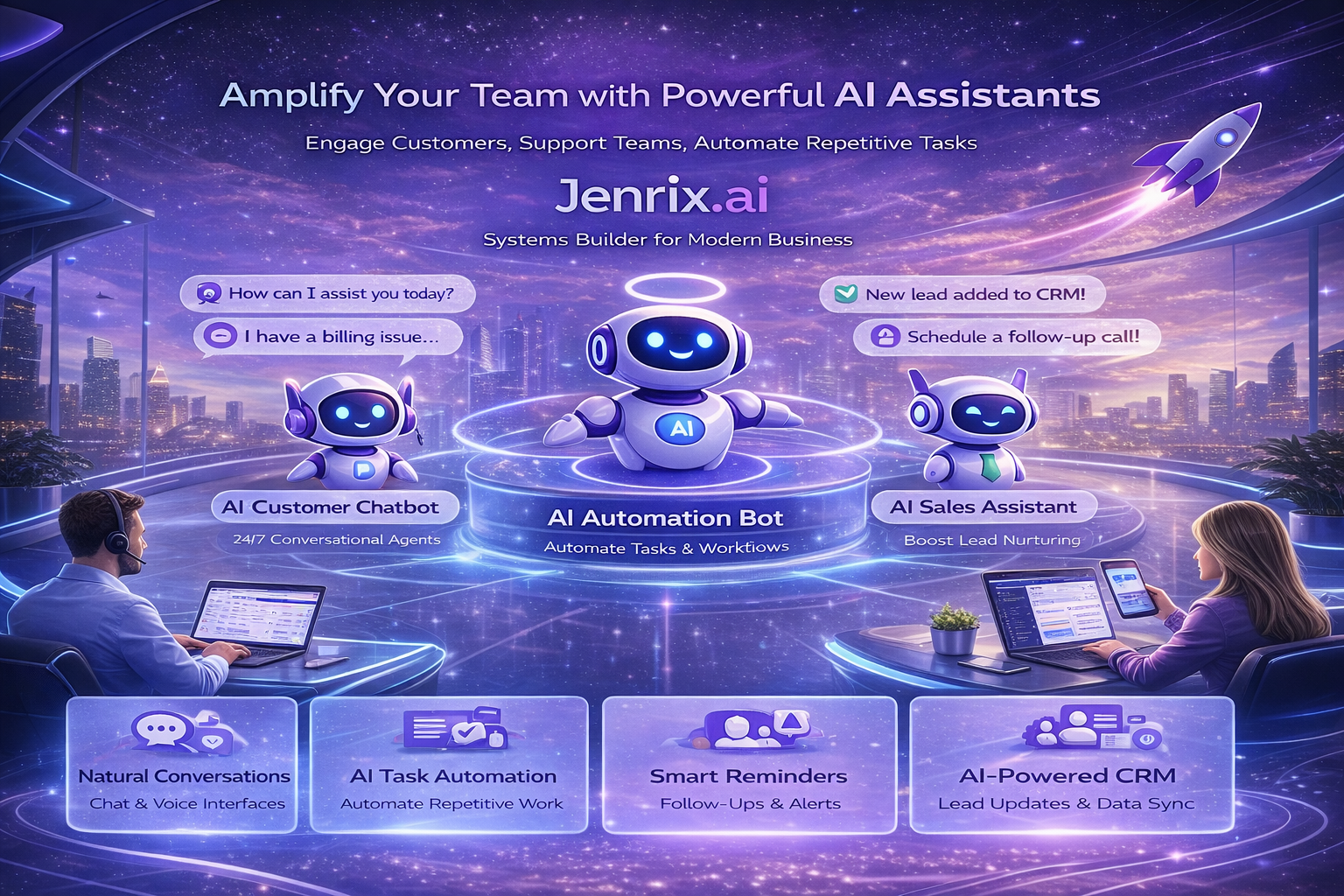
Your existing AI assistant image remains useful as a supporting reference, while the live system above explains how the assistant actually connects context, knowledge, guidance and action.
JENRIX / AI ASSISTANT REFERENCE
ASSISTANT LAYER CONNECTED
AI ASSISTANT USE CASES
Different users need different assistant behavior.
The right design depends on who is using the assistant, what information they need, which workflows they participate in and how much action authority the system should have.
Customer Enquiry Assistants
For product information, qualification, common questions, service guidance and early-stage interaction.
Internal Operations Assistants
For teams needing quick access to process guidance, records, workflows and operational answers.
Product Support Assistants
For SaaS products and digital platforms that want stronger in-product guidance and lower support friction.
Knowledge-Based Assistants
For documentation, policies, internal guidance and structured information that users need to retrieve quickly.
Workflow Guidance Assistants
For users who need help navigating processes, tasks, next actions, forms and procedures.
Embedded AI Interaction Layers
For portals, dashboards, SaaS products and internal platforms where AI should participate directly in the user experience.
GOVERNANCE & HUMAN OVERSIGHT
Useful AI still needs clear operational boundaries.
Enterprise assistants need explicit rules for what they can access, what they can do, when they should escalate and how their behavior is reviewed over time.
Permission-Aware Context
Assistant behavior and information access aligned to user roles and approved sources.
Response Review
Interaction logs, answer quality inspection and improvement feedback loops.
Controlled Actions
Explicit limits around sensitive actions, system changes and escalation conditions.
Escalation & Handoff
Structured transfer to human teams when confidence, policy or business context requires intervention.
AI ASSISTANTS FAQ
Questions businesses ask before deploying AI assistance.
What is an enterprise AI assistant?+
An enterprise AI assistant is an AI interaction layer connected to business knowledge, user context, rules, workflows and systems so it can support real work instead of only producing generic conversational responses.
Can Jenrix build internal AI copilots?+
Yes. Jenrix can build internal copilots for employees, sales teams, support teams, operators, managers and administrators that need faster access to knowledge, workflow guidance and task support.
Can AI assistants connect with CRM and workflow automation?+
Yes. AI assistants can connect with CRM, workflow automation, portals, dashboards, APIs, knowledge sources and internal business applications where the integration and governance model supports it.
How should human handoff work?+
The assistant should recognize when confidence, policy, permissions or business context require human review and transfer the relevant context instead of forcing the user to start over.
BUILD USEFUL AI ASSISTANCE
If AI is entering the business, it should help people do real work.
Jenrix can map the users, knowledge sources, workflows, actions and governance requirements, then engineer an AI assistant around the operating environment instead of adding a disconnected chat interface.