AI / AUTOMATION / DECISION INTELLIGENCE / EXECUTION
AI workflows that move from context to execution.
Jenrix engineers AI business workflows that combine structured process logic, business data, AI-assisted interpretation, human controls and system actions to help operational work move with greater context and consistency.
Instead of treating AI as a separate chat layer, we place intelligence inside the workflow: where information is classified, decisions are supported, tasks are routed, actions are triggered and exceptions return to people.
CONTEXT AWARE
DECISION ASSISTED
HUMAN CONTROLLED
SYSTEM CONNECTED
JENRIX / AI WORKFLOW ORCHESTRATOR
Context → Intelligence → Decision → Execution
ORCHESTRATOR ACTIVE
EVENTS128 ACTIVE
CONTEXTCONNECTED
AIASSISTED
HUMANAVAILABLE
ACTIONSCONTROLLED
JENRIX CORE
ORCHESTRATE
AI / RULES / WORKFLOW / CONTROL
LIVE WORKFLOW EVENT
BUSINESS SIGNAL / CONTEXT ASSEMBLED
INPUTRECEIVED
CONTEXTRESOLVED
DECISIONSUPPORTED
ACTIONCONTROLLED
TRACERECORDED
AI WORKFLOW SYSTEM01
Automation executes rules. AI can add interpretation.
Use deterministic automation where rules are sufficient and introduce AI where classification, extraction, summarisation, recommendation or contextual interpretation can improve the process.
INPUTEvents & Data
INTELLIGENCEInterpretation
CONTROLRules & Humans
OUTPUTBusiness Action
WHERE STANDARD AUTOMATION STOPS
Not every operational decision fits a simple if/then rule.
Processes often contain documents, free text, incomplete signals, exceptions, prioritisation and judgement points. Carefully governed AI can complement deterministic automation at those steps.
Reliable when inputs and conditions are already known.
- Triggers follow predefined conditions
- Structured inputs are easy to route
- Unexpected context requires manual intervention
- Documents and free text need separate handling
- Complex exceptions break straight-through paths
Rules remain in control while AI handles selected interpretation.
- AI can classify, extract, summarise and recommend
- Business rules define boundaries and permissions
- Human approvals remain explicit where needed
- Actions connect through controlled interfaces
- Workflow events and outcomes remain observable
AI WORKFLOW CAPABILITIES
Intelligence belongs inside the process architecture.
Jenrix combines workflow engineering, integrations, AI capabilities and operational controls around a defined business outcome rather than adding intelligence without process ownership.
AI Classification & Routing
Interpret messages, documents, requests or records and route work using business context.
Document Intelligence
Extract, summarise and structure information from operational documents for downstream workflows.
Decision Support
Generate summaries, recommendations, priorities and contextual signals for human or system decisions.
Workflow Orchestration
Coordinate stages, owners, rules, AI steps, approvals, timers and connected-system actions.
System Actions
Create tasks, update records, send communications and invoke APIs through controlled workflow steps.
Human Review & Escalation
Route uncertain, sensitive or policy-bound cases to the appropriate people with context attached.
Workflow Monitoring
Track stage movement, exceptions, turnaround, AI usage and operational outcomes.
Enterprise Connectivity
Connect CRM, ERP, portals, messaging, data services, APIs and internal applications.
AI WORKFLOW REFERENCE
The visual should explain how intelligence moves through work.
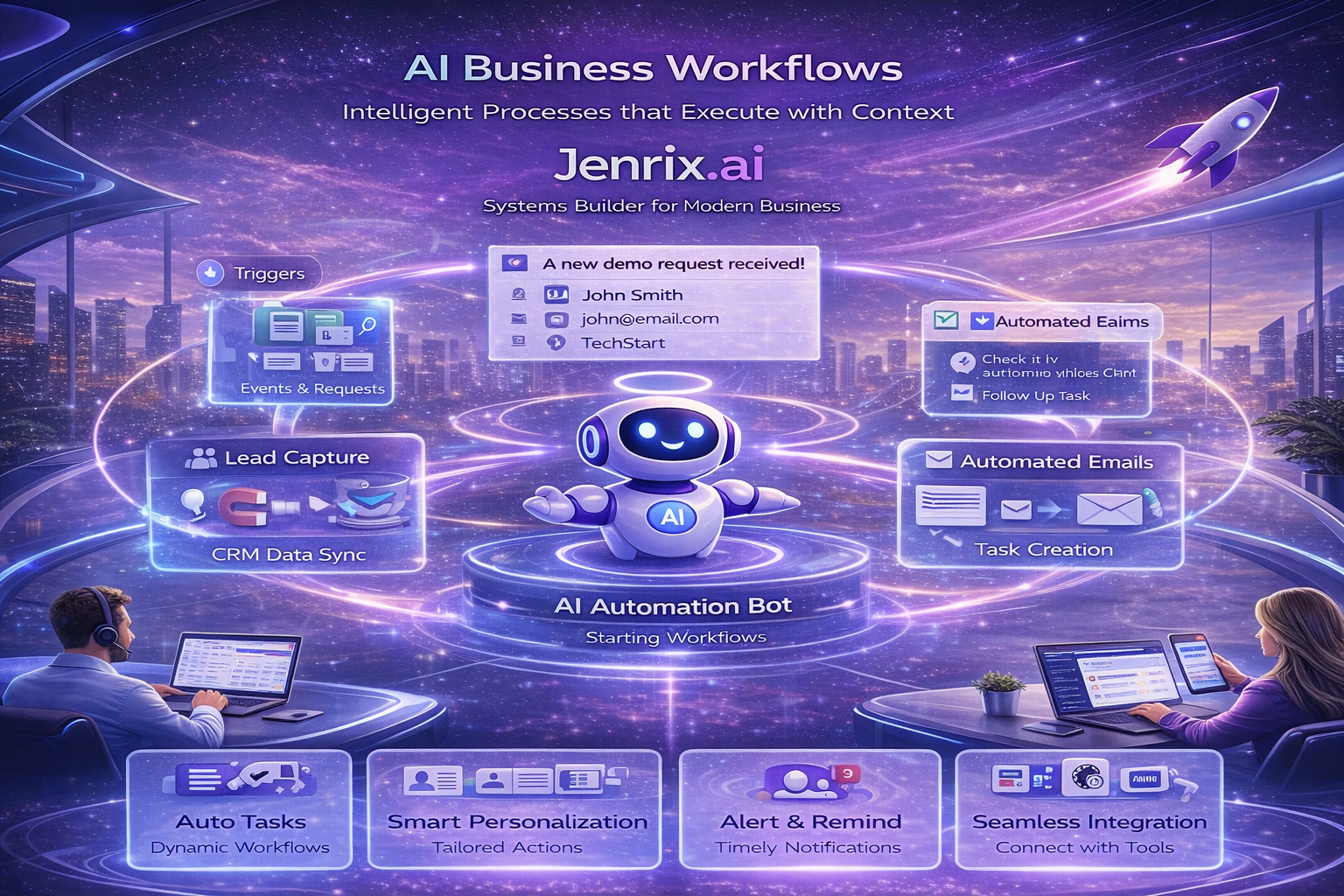
Your existing AI workflow image remains a supporting reference. The live architecture above is the primary explanation because it communicates process, control and execution more clearly.
JENRIX / AI BUSINESS WORKFLOW REFERENCE
ORCHESTRATION LAYER CONNECTED
AI WORKFLOW USE CASES
Use AI where context matters and automation where rules are enough.
The architecture should separate deterministic workflow logic from AI-assisted interpretation, with human control retained where risk, confidence or policy requires it.
Lead Qualification & Follow-Up
Interpret enquiries, enrich context, prioritise leads and trigger controlled follow-up workflows.
Document Processing
Extract operational information, validate fields, summarise documents and route exceptions.
Operational Triage
Classify requests, identify priority, assemble context and assign work to the appropriate path.
Customer Service Workflows
Interpret cases, retrieve relevant context and support structured resolution or escalation.
Decision & Approval Support
Prepare summaries and recommendations while retaining human decision authority.
Exception Management
Detect unusual conditions, explain context and route them to appropriate reviewers.
CONTROL BEFORE AUTONOMY
AI workflow design needs explicit operational boundaries.
The system should make clear which decisions are deterministic, which are AI-assisted, which require human approval and which actions can be executed automatically.
Deterministic Boundaries
Use explicit business logic where conditions are known and auditable.
Selected Intelligence
Introduce AI only at steps that benefit from contextual interpretation.
Approval Authority
Retain human control for sensitive, uncertain or high-impact decisions.
Observability
Record workflow movement, AI usage, exceptions, actions and outcomes.
AI WORKFLOW FAQ
Questions before adding intelligence to automation.
What is an AI business workflow?+
A structured business process that combines deterministic workflow logic with selected AI capabilities for interpretation, classification, extraction, recommendation or decision support.
How is it different from standard automation?+
Standard automation follows predefined conditions. AI can be introduced at steps where the workflow must interpret less-structured information or produce contextual assistance.
Can human approvals remain in the workflow?+
Yes. Human review should remain explicit where business risk, policy, confidence or authority requires it.
ENGINEER INTELLIGENT EXECUTION
AI should improve the workflow, not make it harder to control.
Jenrix can map your process, data, decision points, integrations and human controls, then engineer the right combination of deterministic automation and AI-assisted workflow steps.